
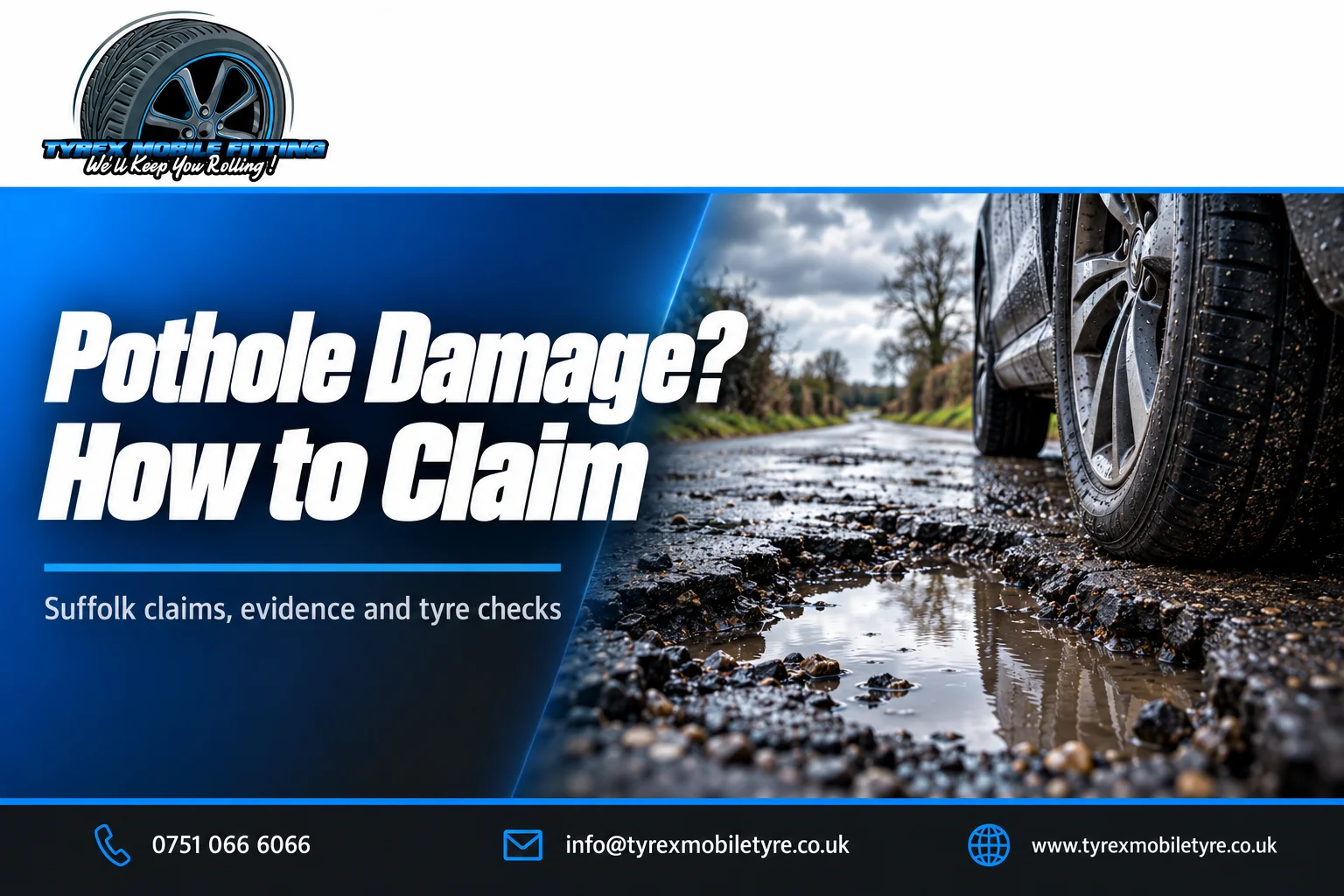
Pothole Damage in Suffolk: How to Claim and Protect Your Tyres
After a wet winter, potholes appear on almost every road in Suffolk, from country lanes near Hadleigh to busy routes into Ipswich. The AA reported that its patrols attended 17% more pothole-related incidents in January 2026 than in January 2025, after one of the wettest Januaries in years. Many of those drivers faced the cost of a new tyre or wheel.
If a pothole has damaged your car, you may be able to claim the cost back. This guide explains who is responsible for the road, how a pothole damage claim works with Suffolk County Council, what evidence you need and how to protect your tyres in the meantime.
What a Pothole Can Do to Your Tyres and Wheels
A pothole hits a tyre with a sharp, concentrated impact. The tyre is squeezed between the edge of the hole and the wheel rim, and that can cause damage you might not see straight away.
- A bulge or lump in the sidewall, which means the internal cords have broken
- A cut or split in the sidewall
- A sudden puncture or a slow leak where the tyre seals against the rim
- A bent, cracked or buckled alloy wheel
- Knocked-out wheel alignment, which causes uneven tyre wear and the car pulling to one side
- Damage to suspension parts, such as springs or track rod ends
A sidewall bulge is a serious warning sign. The tyre can fail without warning and must be replaced; it cannot be repaired.
What to Do Straight After Hitting a Pothole
Pull over as soon as it is safe and switch on your hazard lights. Walk around the car and check each tyre and wheel for bulges, cuts and loss of pressure. If the steering feels different or the car is pulling, take it seriously even if nothing looks wrong.
If it is safe, take photos of the pothole and the damage before you leave. If a tyre is flat or damaged, do not drive on it. Our guide on whether you can drive on a flat tyre explains why. Call our emergency tyre fitting team instead and we will come to you.
Who Is Responsible for the Road?
You need to claim from the authority that maintains the road where the damage happened.
- Suffolk County Council looks after most roads in Suffolk, including town roads, B roads and country lanes
- National Highways maintains the A14 (Midlands to Felixstowe), the A12 south of Ipswich towards Colchester and London, the A11 and the northern section of the A47
- In north Essex, including Colchester, Manningtree and Clacton-on-Sea, local roads are the responsibility of Essex County Council
If you are not sure, note the road name and nearest junction. The council can tell you whether a road is theirs.
How to Make a Pothole Damage Claim with Suffolk County Council
Suffolk County Council handles damage claims through its highways insurance process. These are the steps it sets out.
Step 1: Report the Pothole
Report the defect using the council’s online Report a Highways Issue tool, which gives you a report reference number. If the pothole is an urgent danger, call the highways emergency line on 0345 606 6171.
Step 2: Email Customer Services
Email customer.services@suffolk.gov.uk with your report reference and say you want to start an insurance claim. If the pothole has already been repaired, say so in your email.
Step 3: Complete the Highway Incident Report Form
The council sends a claim reference and an information leaflet. To go ahead, you complete a highway incident report form and send your evidence, a copy of your insurance certificate and proof that the vehicle was taxed on the date of the incident.
Step 4: Wait for a Decision
The council says its claims handlers will contact you within 90 days to say whether the claim is accepted, although severe weather can cause delays.
What Evidence Will You Need?
Strong evidence makes a successful pothole damage claim more likely. Collect as much as you can:
- The exact location, road name, nearest house number or junction, and the date and time
- Photos of the pothole with an object for scale, such as a shoe or a tape measure
- Photos of the damage to your tyre, wheel or car
- Names and contact details of any witnesses
- The repair invoice or a written quote, including the tyre size and the work done
- Any receipts for extra costs, such as a taxi or recovery
When Tyrex replaces a pothole-damaged tyre, we can give you an invoice that lists the damage and the work carried out, which you can include with your claim.
Why Many Pothole Claims Are Rejected
Claims are not always paid. Freedom of Information figures published by Suffolk County Council show 718 road defect claims in 2023, of which 104 were paid and 609 were rejected. In 2024 there were 542 claims, with 76 paid and 453 rejected.
To succeed, you need to show that the defect was hazardous, that the council was negligent and that the defect caused your loss. Under Section 58 of the Highways Act 1980, a council can defend a claim if it can show it had a reasonable system for inspecting and repairing the road. If your claim is rejected, you can ask to see the inspection records for that road and appeal, and some drivers go on to the small claims court after taking advice.
Should You Claim on Your Car Insurance Instead?
If the damage goes beyond a tyre, for example a cracked wheel or broken suspension, your insurer may be an option if you have comprehensive cover. You will usually pay the excess, and a claim can affect your no-claims discount, so compare the repair cost with your excess first. For a single tyre, claiming from the highway authority or simply paying for the replacement is usually more sensible. Either way, keep the invoice and photos, because a successful pothole damage claim against the council can still recover your costs later.
Check Again a Few Days Later
Some pothole damage only shows up after a few days of driving. Check the tyre again for a slow loss of pressure, a new bulge or uneven wear, and notice whether the steering wheel is straight when you drive in a straight line. A vibration at motorway speeds can mean a bent wheel or a balance problem.
Claiming in Essex
If the damage happened on a local road in north Essex, report the defect to Essex County Council through Essex Highways and follow its claims process. The same evidence applies: location, photos, witnesses and repair invoices. For the A12 between Ipswich and Colchester, the claim goes to National Highways.
How to Reduce Pothole Damage
You cannot avoid every pothole, but you can lower the risk of damage:
- Keep tyres at the correct pressure, as underinflated tyres are more easily pinched against the rim
- Replace tyres before the tread gets low; our winter car checks explain what to look for
- Slow down on rough roads and leave more space to the car in front so you can see the surface
- Treat puddles with caution, as they often hide deep potholes
- Avoid braking hard over a pothole; brake before it and roll over it with the wheels straight
Tyre Damaged by a Pothole? We Come to You
If a pothole has left you with a flat or a bulging tyre, there is no need to drive on it. Our mobile tyre fitting team covers Ipswich, Bury St Edmunds, Stowmarket, Hadleigh, Colchester and the rest of Suffolk and north Essex. We can repair a puncture where it is safe, or carry out a mobile tyre replacement at your home, workplace or a safe roadside spot.
Frequently Asked Questions
Can I claim for pothole damage in Suffolk?
Yes. Report the pothole to Suffolk County Council, then email customer services to start an insurance claim and complete the highway incident report form with your evidence.
How long does Suffolk County Council take to decide a pothole claim?
The council says its claims handlers will contact you within 90 days, although severe weather can cause delays.
Who do I claim from if I hit a pothole on the A14 or A12?
The A14, the A11 and the A12 south of Ipswich are maintained by National Highways, so the claim goes to National Highways rather than the council.
What evidence do I need for a pothole claim?
Photos of the pothole and the damage, the exact location and time, witness details, repair invoices or quotes, your insurance certificate and proof the vehicle was taxed.
Can I drive on a tyre with a bulge after hitting a pothole?
It is not safe. A bulge means the tyre’s internal structure is damaged and it can fail suddenly. Replace the tyre as soon as possible.
Does car insurance cover pothole damage?
Comprehensive policies often cover it, but you will usually pay the excess and it may affect your no-claims discount. For tyre-only damage, claiming from the highway authority or paying for the tyre yourself is often simpler.
How do I report a pothole in Suffolk?
Use Suffolk County Council’s online Report a Highways Issue tool. For urgent dangers, call the highways emergency line on 0345 606 6171.